
Petrol price on Thursday was cut by Rs 6.07 per litre and diesel price by Rs 11.75 in Delhi as oil companies passed on a record reduction in excise duty rates to consumers. Buckling under pressure, the government had on Wednesday cut excise duty on petrol by Rs 5 per litre and that on diesel by Rs 10 a litre to give reprieve to consumers battered by record high retail fuel prices. Since states charge local sales tax or VAT not just on the base price but also on the excise duty levied by the centre, the total incidence of price reduction is higher.

Petrol price on Thursday was cut by 16 paise per litre and diesel by 14 paise -- the fourth minor reduction in rates in three weeks that followed six months of relentless price increases. Petrol now costs Rs 90.40 per litre in Delhi, down from Rs 90.56, according to a price notification of state-owned fuel retailers. A litre of diesel comes for Rs 80.73 per litre as against Rs 80.87 previously.
Petrol price on Tuesday was increased by 15 paise per litre and diesel by 18 paise as State-owned fuel retailers started passing on the increase in international oil prices to consumers after an 18-day hiatus.
Indian Oil Corporation (IOC) on Tuesday reported halving of its March quarter net profit largely because of losses in the petrochemical business and shrinking margin after it announced a pre-election fuel price cut despite rising input costs. The net profit of Rs 4,837.69 crore in January-March compared to Rs 10,058.69 crore a year back and Rs 8,063.39 crore in the preceding October-December quarter, according to a stock exchange filing by the company.

Prime Minister Manmohan Singh on Saturday hinted at replacing the current practice of fortnightly revision of petrol and diesel prices with a more stable pricing policy once the volatile international crude prices stabilise.

Government schemes such as the PM E-Drive initiative, with allocations of around Rs 2,000 crore for charging points deployment, are helping accelerate rollout
The government on Friday decontrolled petroleum prices to bring fuel costs in line with global oil rates after an Empowered Group of Ministers, headed by Finance Minister Pranab Mukherjee, met for the second time in less than three weeks to decide on raising fuel prices. Railway Minister Mamata Banerjee was absent again.

Finance Minister Nirmala Sitharaman's biggest challenge will be to find a new growth driver, particularly against the backdrop of a global economy ravaged by heightened uncertainty and fragmentation, financial markets on a precipice, and global commodity prices on a continued uptrend.

Will rising tensions between US-Israel and Iran threaten crude oil supply through the Strait of Hormuz, putting India's fuel prices, imports, and economic stability at risk?
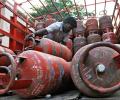
Former Haryana Chief Minister Bhupinder Singh Hooda criticises the state government over alleged LPG cylinder shortages and black marketing, urging immediate action to alleviate public hardship. He also addresses concerns regarding farmers' MSP and the SYL canal issue.

The 'rescue' operation occurred within kilometres of Iran's underground tunnel complex at Isfahan, assessed by the IAEA and US intelligence as holding a substantial portion of the country's 60 per cent enriched uranium stockpile. Retired senior US military officers have highlighted that the mission's footprint -- hundreds of special operators, multiple heavy-lift aircraft deep inside Iran -- appears outsized for recovering a single airman. Prem Panicker continues his must read blog on the Iran War.
The Kelkar Committee, which was appointed by Finance Ministry to suggest a roadmap for fiscal consolidation, has suggested immediate hike in fuel prices and complete deregulation of diesel prices by start of 2014-15 fiscal.
Top Indian cement firms are expected to report a strong earnings growth for the second quarter of the financial year 2025-26 (Q2FY26) on a year-on-year (Y-o-Y) basis, amid improved realisations, prices, and steady volume growth, but on a low base.

The 63-seater open-top bus, manufactured by Ashok Leyland's arm Switch Mobility, was gifted to the city's tourism department as a corporate social responsibility initiative.
The Union oil ministry is considering a proposal to adopt differential pricing for diesel, under which industrial users like power utilities, will be charged market prices and retail consumers continue to be subsidised.
State-owned oil companies have announced a hike in petrol prices between 37 and 40 paise in the major cities, while diesel will be costlier by 37 to 44 paise with effect from midnight on Friday.

'The next two to three weeks will not be decided in Washington.' 'They will be decided in Tehran, in whatever calculation Iran makes about the costs of continued resistance against the costs of appearing to have yielded.'
The 17th daily increase in rates, since oil companies on June 7 restarted revising prices in line with costs after ending an 82-day hiatus in rate revision, has taken diesel prices to fresh highs.

In 16 days, petrol price has been hiked by Rs 8.3 per litre and diesel by Rs 9.46 - a record increase in rates of the fuel in any fortnight since pricing was deregulated in April 2002.
Diesel likely to get cheaper in New Delhi

Taking Kharg would give the US control over virtually all of Iran's oil exports and thus provide significant leverage, notes Prem Panicker in his must read daily blog on the Gulf War. It would also put American troops within range of Iran's remaining missiles, drones, and artillery on a piece of real estate that is just eight square miles in size, and just 15 miles from the Iranian mainland.

Renault India on Saturday said it will reduce prices of its vehicles by up to Rs 96,395 to pass on full benefit of the recent GST rate cut to buyers. The GST Council, earlier this week, approved limiting slabs to 5 per cent and 18 per cent, effective from September 22.

Tata Motors on Friday said it will cut passenger vehicle prices ranging between Rs 65,000 and Rs 1.45 lakh effective September 22 to pass on the full benefit of GST reduction to customers. The Mumbai-based auto major said that its small car Tiago will see a price drop of Rs 75,000, Tigor Rs 80,000, and Altroz Rs 1.10 lakh.

You know the Tata Sierra is a true icon when driving on the highways and hill climbs of Chandigarh, the car instantly drew all eyes to it.

JSW MG Motor India will launch four new models this year, and is planning to invest between 3,000 crore-4,000 crore in the country over the next couple of years. The new models include a plug-in hybrid, an electric vehicle, the Majestor SUV and one additional model yet to be disclosed.
The Reserve Bank on Tuesday said the government should deregulate diesel prices in order to contain the trade deficit, which is expected to widen to $160 billion during the current fiscal.

Oil Ministry felt it did not have a clear mandate to reduce rates post the January 2013 decision of the Cabinet to raise prices by 40-50 paisa a litre every month.

The 1.5-litre Hyperion petrol engine masterfully blends everyday driving with a sophisticated, tech-laden interior that elevates the entire experience.

This will be the sixth consecutive price cut for petrol since August.
The current complex pricing of diesel will give rise to bribery and law-breaking.
A litre of diesel will cost Rs 48.01 compared to Rs 49.31 at present

Petrol price had been cut 10 times since August 2014.

State-owned Oil and Natural Gas Corporation (ONGC) has reported a 10 per cent decline in its June quarter net profit on lower oil prices and stagnant production from its aging fields. The company reported a net profit of Rs 8,024 crore in the first quarter of 2025-26 fiscal year, compared to Rs 8,938 crore earning in the same period last year, a company statement said.
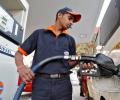
Diesel price on Monday went past the Rs 98-a-litre mark in a few places of Rajasthan as a relentless increase in fuel prices took rates to record-high levels. Petrol price was increased by 29 paise per litre and diesel by 26 paise a litre, according to a price notification of state-owned fuel retailers. The increase - 16th this month - pushed petrol and diesel prices to a fresh all-time high across the country. Sri Ganganagar district of Rajasthan saw petrol price climb to Rs 105.24 a litre and diesel to Rs 98.08 per litre.

Electric vehicle (EV) penetration in the luxury car segment has seen a drop by nearly 3 percentage points in the GST 2.0 era with the internal combustion engine versions offering better total cost of ownership, according to industry players. While the trend is also visible in the mass market segment, it is the entry luxury segment that is witnessing a more marked shift towards internal combustion engine (ICE) vehicles as price difference between EV and ICE widened under the new GST rates.

The price of jet fuel (ATF) was sharply increased by 7.5 per cent on Tuesday, while the cost of LPG used in commercial establishments was reduced by Rs 58.50 per cylinder, reflecting shifts in international benchmark rates. After three rounds of price cuts, aviation turbine fuel (ATF) price was increased by Rs 6,271.5 per kilolitre, or 7.5 per cent, to Rs 89,344.05 per kl in the national capital - home to one of the busiest airports in the country, according to state-owned fuel retailers.
Petrol price may be reduced by about Re 1 per litre while diesel price may be hiked by 40-50 paisa a litre from March 15/16.

According to a report by rating and research agency CRISIL, it now takes six years to recover the premium-between Rs 100,000 on small cars and Rs 300,000 on luxury sedans-paid for diesel variants.
The government on Tuesday ruled out any further increase in diesel and cooking fuel prices even though the current retail rates are lower than their cost of production.
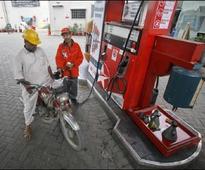
The government on Tuesday said it has agreed in-principle to deregulate diesel prices, but is not considering similar proposal for the cooking gas.
